
Series Resources
sermon-based study guide
2026-11-15 | Series Resource Guide | Becoming in the Age of Algorithms
📘 Becoming in the Age of Algorithms | Resource Guide
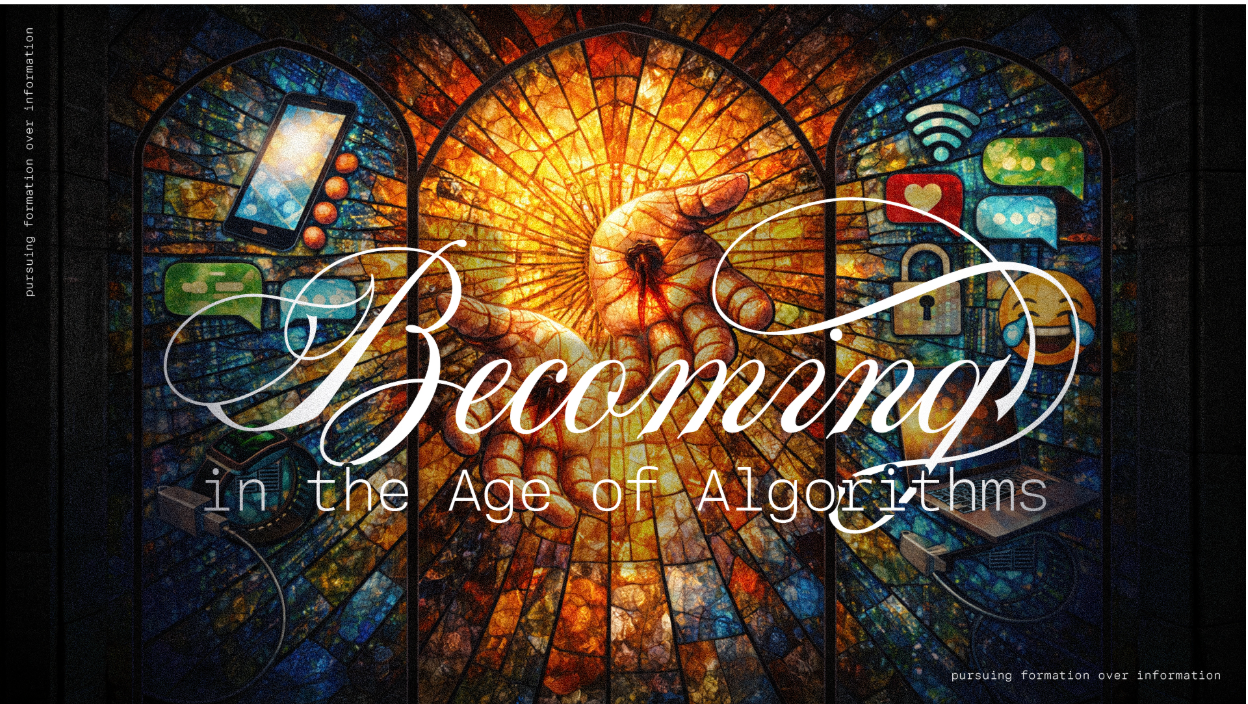
Dates: November 15–22, 2026
Subtitle: Pursuing Formation within Dysinformation
Tag Line: Pursuing formation over information.
Key Passages:
Deuteronomy 6:4–9; 1 Corinthians 6:12; John 8:31–36; John 10:10
Acts 2:42–47
SERIES OVERVIEW
What did the phone make easier? What did it make harder? It made it easier to find our way, reach a friend, and learn something new. It can also make it harder to sit through a quiet moment or give someone our whole attention. Those small changes add up. Over time, what we do again and again shapes who we become.
In the Glitch series , we named four things digital life can imitate: awe, agency, identity, and intimacy. This series takes the next step. We use dysinformation to describe what happens when the way we receive information forms us poorly, even when the information is true. A stream of accurate headlines can still leave us less patient with the person who walks through the door.
Over two weeks, we move from a phone on a pedestal to bread and a cup at a table. We begin by noticing what has a hold on our attention and choosing a boundary. Then we turn to the practices that help us become more like Jesus together: Scripture and prayer, shared meals, generosity, and worship. We carry those practices into the world we already live in.
FORMATION PRACTICE
The Audit
Choose one input and one practice to take its place. Keep the Audit through both weeks of the series and for the month afterward. Try it with a friend or your Life Group.
1. Identify the input. Choose the app, feed, or platform you reach for without thinking. Check your recent use or make an honest estimate. Notice when you reach for it and what you’re hoping it will give you.
2. Cut that input in half. Use your usual time as a starting point. If you spend about an hour on it each day, aim for thirty minutes. Choose one of the sermon’s boundaries: see it by making your usage visible, set a limit, or delete the app for a time.
3. Give that time to a practice. Put a phone-free meal, walk, Life Group, or visit with someone on your calendar. Pick something you can return to. Make at least some of that time available to other people.
Check in after a week: What felt hard? What became possible? If you slip, notice what made the old habit easy to return to and begin again. At the end of the month, decide what you want to keep.
🧭 Series Roadmap
Week 1 — November 15, 2026
Unfollow
Teacher: Phil EuBank
Scripture: Deuteronomy 6:4–9; 1 Corinthians 6:12; John 8:31–36; John 10:10
Big Idea: What you’re scrolling through is scrolling you.
Deuteronomy pictures God’s words at the edges of the day: when we rise, when we lie down, and in the ordinary moments in between. What voices have those places in our lives now? Paul gives us two questions for whatever we reach for: Is it helpful? Does it have a hold on me?
In John 8, Jesus invites us to stay with his words and receive the freedom he gives. A boundary is one way to begin living in that freedom. Notice what you follow, what it asks of you, and where it’s taking you.
Practice: Choose your Audit input and one boundary. Give Scripture the first word on one morning this week.
Week 2 — November 22, 2026
Radiant
Guest Teacher: Tara Beth Leach
Scripture: Acts 2:42–47
Big Idea: Becoming does not happen alone.
Acts 2 shows us what the first believers devoted themselves to: the apostles’ teaching, fellowship, breaking bread, and prayer. They shared what they had, ate together, and praised God. Those practices gave them ways to know one another, recognize needs, and respond with generosity.
At Communion, bread and a cup bring us back to what Jesus has done for us and to the people with whom we receive that gift. The same invitation continues after Sunday: be present long enough to be known and to learn to love the people God has placed around you.
Practice: Use some of the time you’ve reclaimed to share a meal, try a group, or show up for someone. Make a plan to do it again.
HOW TO USE THIS GUIDE
Read the Scripture for each week slowly before returning to the message. Try the Audit as you go. You can use these three questions alone, over a meal, or with a group.
- Notice: What has been getting my attention, and what is it doing to me?
- Stay: Where is Jesus inviting me to slow down and remain with him?
- Share: Who can I be present with, and what would that look like this week?
If you’re doing this with a group, begin by sharing your boundary and what you’re making room for. At the next gathering, ask what people noticed before asking how much time they saved. If you’re looking for people to practice with, start with Menlo’s group finder.
📚 Recommended Reading
Books to Go Deeper
Radiant Church — Tara Beth Leach
A vision for a church whose shared life makes the good news of Jesus visible. Start here to go deeper with Week 2. Radiant Church — InterVarsity Press
The Common Rule — Justin Whitmel Earley
Daily and weekly habits that make room for love of God and neighbor. A practical companion for the Audit. The Common Rule — InterVarsity Press
Restless Devices — Felicia Wu Song
A look at how digital habits shape our sense of self and our ability to be present, with ways to practice a different rhythm. Restless Devices — InterVarsity Press
Life Together — Dietrich Bonhoeffer
A short classic on the ordinary gifts and demands of Christian community, including shared prayer, service, and listening. Life Together — HarperCollins
You Are What You Love — James K. A. Smith
An exploration of how repeated habits shape what we love and how Christian worship can give those loves a different direction. You Are What You Love — Author’s Site
🎧 Podcasts, Courses & Video
Practicing the Way with John Mark Comer
Conversations and teaching on becoming like Jesus through practices that fit into everyday life. Practicing the Way — Podcasts
BibleProject — Pentecost: Acts 1–7
A short video that places Acts 2 in the larger story of the Spirit and the early church. Watch before reading Acts 2:42–47 with a group. BibleProject — Pentecost
Menlo Midweek
Continue the conversation through Menlo’s companion podcast. Menlo Church — Podcasts
🧠 Key Concepts & Practices
Formation
The slow process of becoming a certain kind of person. What we repeatedly give our time and attention to can change what we love and how we respond to others.
Dysinformation
The series’ word for the ways an information environment can form us poorly. The question is both whether what we’re taking in is true and what the pattern of taking it in is doing to us.
Freedom and Limits
Paul asks whether something helps and whether it has power over him. A good limit can give us room to choose where our attention goes and who receives it.
Abiding
Staying with Jesus and letting his words shape how we live. Try reading one passage slowly and returning to one line when you’re waiting, worried, or about to react.
Embodied Community
The shared life we practice with other people: learning names, making room at a table, praying together, and helping when someone has a need. Acts 2 gives us a picture of what that can become.
✍️ Reflection & Prayer Prompts
- What gets the first and last word in my day? What does that voice teach me to expect or desire?
- What am I usually looking for when I reach for my phone: rest, reassurance, distraction, company, or something else?
- What do I notice about myself when I can’t check the thing I usually check?
- What is one good use of technology I want to keep? What is one use I need to limit?
- What truth from Jesus do I need to stay with long enough for it to change a choice?
- Where am I tempted to treat a boundary as a test of my worth? What does John 8 say about who gives freedom?
- Which practice in Acts 2 feels most absent from my week? Who might I try it with?
- Who receives more of my attention when the feed receives less? What could I put on the calendar to make that possible?
A Prayer for the Series
Jesus, you know what we reach for when we are lonely, anxious, tired, or afraid of missing something. Thank you for the good our tools make possible. Help us notice when they start taking more than we meant to give. When we set them down and the quiet brings up something hard, help us stay with you and tell you what is true.
Give us the freedom you promise in John 8. Teach us to keep your words close when we rise and when we lie down. Give us courage to try one boundary, patience when change is slow, and someone with whom we can be honest and begin again.
Make us a church that lives what we see in Acts: people who learn together, share what we have, pray for one another, and make room at the table. Bring to mind someone we could listen to, welcome, or help this week. Let the time we recover become time we offer in love. Amen.