
Series Resources
sermon-based study guide
Glitch | Series Resource
📘 Glitch — Resource Guide
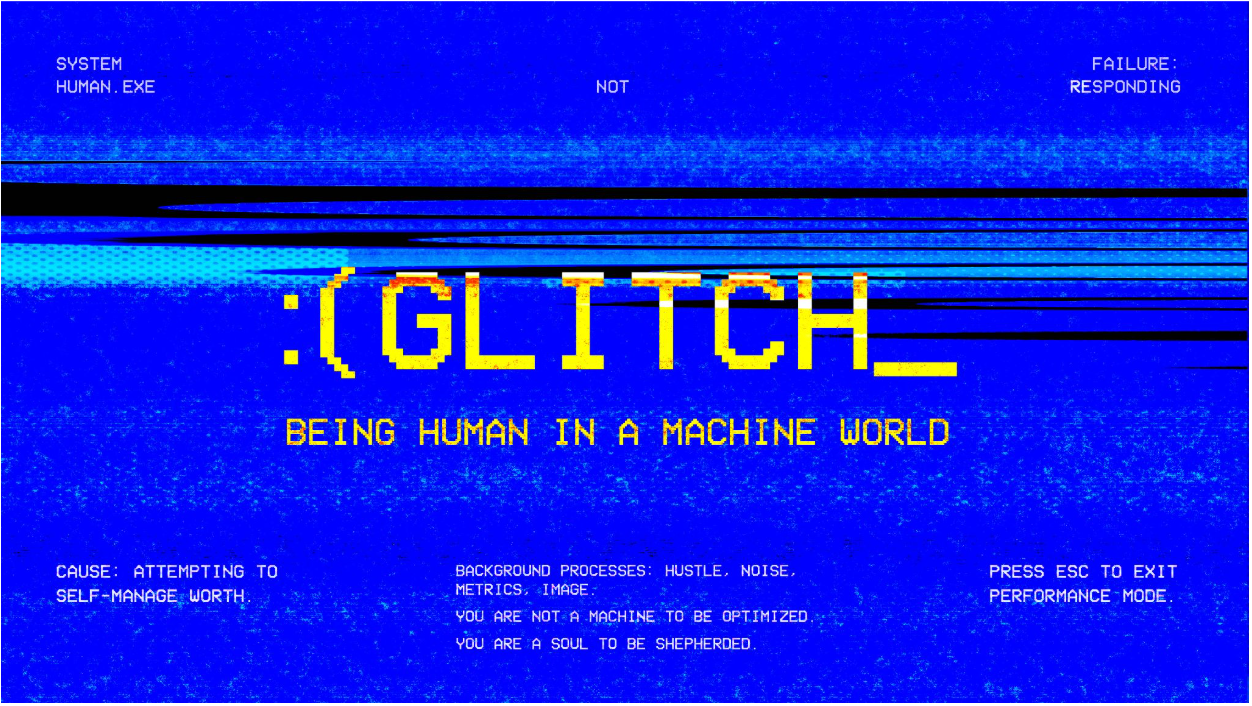
Dates: May 24 – June 14, 2026
Subtitle: Being Human in a Machine World
Key Passages: Psalm 139; Romans 12:1–2; 1 Kings 19:1–9; Matthew 11:28–30
Formation Practice
We are not machines to be optimized. We are souls to be tended. Throughout this series, practice slowing down long enough to recover awe, presence, and connection.
Each Week:
- The Analog Hour:
Take one intentional hour each week away from screens, notifications, earbuds, and productivity metrics. Walk. Pray. Sit. Notice. - The System Reboot (Breath Prayer):
Breathe in: “I am known.” Breathe out: “I am not alone.” - Stop When You’re Not Finished:
Practice leaving something undone as an act of trust instead of control. - Mark Moments With God:
Write down, photograph, or journal moments where you noticed God’s presence in ordinary life.
Series Synopsis
Glitch is a series about recovering what it means to be human in a machine world. Across four weeks, we’ll confront anxiety loops, burnout, performance culture, disconnection, and the growing pressure to live beyond our God-given limits.
But instead of treating our glitches as failures, we’ll explore the possibility that they are actually merciful signals — reminders that we were never meant to carry infinite demand. God does not invite us deeper into performance. He invites us into awe, rest, presence, surrender, and community.
This series isn’t about rejecting technology; it’s about refusing to lose our humanity inside it.
🧭 Series Roadmap
Week 1
May 24
Fatal Error
Psalm 139:1–14
Your glitches are beacons, not bugs.
Week 2
May 31
Infinite Loop
Romans 12:1–2; 2 Corinthians 10:5
You can’t out-think a broken feeling.
Week 3
June 7
Hardware Crash
1 Kings 19:1–9
Your body is not the enemy of your soul.
Week 4
June 14
Going Offline
Matthew 11:28–30
Connection is the cure for isolation.
📚 Recommended Reading
Books to Go Deeper
- The Ruthless Elimination of Hurry — John Mark Comer
- The Anxious Generation — Jonathan Haidt
- Renovation of the Heart — Dallas Willard
- Digital Minimalism — Cal Newport
- The Tech-Wise Family — Andy Crouch
- Anatomy of the Soul — Curt Thompson
- The God-Shaped Brain — Timothy Jennings
- Winning the War in Your Mind — Craig Groeschel
Bible Studies / Devotionals
- New Morning Mercies — Paul David Tripp
- Emotionally Healthy Spirituality Day by Day — Peter Scazzero
- Practicing the Way — Sabbath & Silence Practices
- Lectio 365 — Guided Prayer & Reflection
🎧 Podcasts & Messages
- Practicing the Way Podcast — John Mark Comer
- The Place We Find Ourselves — Adam Young
- Rebuilders — Mark Sayers
- Nothing Wasted Podcast
- Mere Fidelity (episodes on technology & formation)
🌐 Websites
- practicingtheway.org — Practical spiritual practices for everyday discipleship
Helps people build rhythms of silence, Sabbath, Scripture, and presence in a distracted world. - emotionallyhealthy.org — Emotional health and spiritual formation resources
Tools and teaching for integrating emotional maturity with Christian discipleship. - renovare.org — Spiritual formation rooted in abiding with God
Resources focused on prayer, attentiveness, and life with God beyond performance. - theanxiousgeneration.com — Research and insights on technology, attention, and mental health
Helpful cultural context for understanding the effects of phones, social media, and digital life. - telosconference.com — Faith, work, and technology conversations from a Christian perspective
Includes resources connected to AI, ethics, and human flourishing in Silicon Valley.
🧠 Key Concepts & Practices
Spiritual Practices to Try
The Analog Hour
Take 60 intentional minutes away from screens each week to reconnect with God, creation, and your own soul.
Stop When You’re Not Finished
Practice ending work before exhaustion decides for you.
Awe Without Documentation
Experience beauty without needing to capture, post, or optimize it.
Breath Prayer
Use short prayers throughout the day to interrupt anxiety and re-center your awareness of God’s presence.
Key Terms
Awe
The experience of encountering something greater than yourself that reshapes perspective and posture.
Glitch
A merciful signal that something in our current way of living is incompatible with how God designed us.
Habituation
The tendency to normalize wonder, beauty, or even God’s faithfulness over time.
Presence
Living aware of God instead of merely aware of productivity, urgency, or distraction.
Limits
God-designed boundaries that remind us we are human, not infinite.
🙌 Community & Next Steps
- Join a Serve Team
- Practice the “60-Minute Experiment” with family or friends
- Invite someone exhausted, anxious, or spiritually disconnected to church
- Explore counseling, spiritual direction, or trusted community support if needed
Weekly Challenge
“This week, I will unplug from ________ so I can reconnect with ________.”
✍️ Reflection & Prayer Prompts
- Where do you feel most emotionally or spiritually overloaded right now?
- What “looping thought” keeps replaying in your mind?
- What limits are hardest for you to accept?
- When was the last time you experienced awe without distraction?
- What might God be trying to say through your exhaustion or anxiety?
- What would it look like to stop performing and let yourself simply be known?
Prayer
God, thank You that we are fully searched and fully known by You,
and that Your knowledge of us is not surveillance, but love.
Help us receive our limits as gifts instead of fighting them as failures.
Teach us to notice awe again, to stop when we are not finished,
and to trust that You are present even in the places
we have been too hurried or overwhelmed to see.
Remind us that our glitches are not fatal,
because Jesus has come near,
and because You never crash, never leave,
and never stop holding us.
Amen.
📌 Special Resources + Q & A
WEBSITES:
CHRISTIAN COUNSELING RESOURCES:
- Q: What is mental health?
- A: Being mentally healthy has a lot to do with being integrated as a person. Are our thoughts in alignment, with our beliefs, and our actions? It’s disintegration that produces mental illness. Sometimes the disintegration is organic which means that the brain isn’t functioning in a balanced manner. Other times, the disintegration is a product of a circumstantial event or trauma. It can originate at the behavioral level as in we make choices that cause harm to our mind and body. Mental health symptoms can also be a product of having core beliefs about ourselves/other people that create unhelpful patterns such as comparison. The difference between expected stress and sadness vs. a pathology is that the symptoms get in the way of our ability to complete our daily tasks and/or negatively impact our relationships. The field of mental health is so complex and it takes time and a trained expert to diagnose and provide appropriate treatment.
- A: Being mentally healthy has a lot to do with being integrated as a person. Are our thoughts in alignment, with our beliefs, and our actions? It’s disintegration that produces mental illness. Sometimes the disintegration is organic which means that the brain isn’t functioning in a balanced manner. Other times, the disintegration is a product of a circumstantial event or trauma. It can originate at the behavioral level as in we make choices that cause harm to our mind and body. Mental health symptoms can also be a product of having core beliefs about ourselves/other people that create unhelpful patterns such as comparison. The difference between expected stress and sadness vs. a pathology is that the symptoms get in the way of our ability to complete our daily tasks and/or negatively impact our relationships. The field of mental health is so complex and it takes time and a trained expert to diagnose and provide appropriate treatment.
- Q: What is faith-based therapy?
- A: Integrating Christ-centered beliefs, spiritual disciplines, and scripture into the psychotherapy process. It is different from Biblical counseling as faith-based therapy is conducted by a licensed professional therapist who specializes in the culture of Christianity and is a Christian themselves.
- A: Integrating Christ-centered beliefs, spiritual disciplines, and scripture into the psychotherapy process. It is different from Biblical counseling as faith-based therapy is conducted by a licensed professional therapist who specializes in the culture of Christianity and is a Christian themselves.
- Q: Can I pray my mental health problems away?
- A: Prayer is a vehicle for relationship development and conversation with God. Prayer can help with feeling closer to God during hardship but God often uses community, wisdom, and other individuals to guide us through hardship. Mental health is often a lengthy process of formation development.
- A: Prayer is a vehicle for relationship development and conversation with God. Prayer can help with feeling closer to God during hardship but God often uses community, wisdom, and other individuals to guide us through hardship. Mental health is often a lengthy process of formation development.
- Q: Am I trusting God if I use antidepressants or other psychotropic medication (medication to address mental health symptoms).
- A: We believe that God is the author of healing. Sometimes, His healing comes through prayer and miracles. And oftentimes, God uses community and experts. Similar to diabetes being treated through insulin therapy. An individual with diabetes is not trusting God less by needing to regulate their production of insulin and the same is true for an individual whose brain might not be producing the right balance of dopamine and serotonin.
- A: We believe that God is the author of healing. Sometimes, His healing comes through prayer and miracles. And oftentimes, God uses community and experts. Similar to diabetes being treated through insulin therapy. An individual with diabetes is not trusting God less by needing to regulate their production of insulin and the same is true for an individual whose brain might not be producing the right balance of dopamine and serotonin.
- Q: Who can treat mental illness?
- A: Primarily a licensed therapist and psychiatrist. Your primary care doctor or nurse practitioner can prescribe psychotropic medication. What people don’t know is that coaches for example are not licensed mental health professionals and cannot use therapeutic interventions. While an executive coach is a great resource for career goals, coaches of all kinds are prohibited from legally addressing mental health symptoms.